Projects, billing and double-entry accounting: one ERP for IT services.
Turn approved hours into invoices, payroll into project costs, and every number into a traceable ledger entry. AI drafts; your team approves.
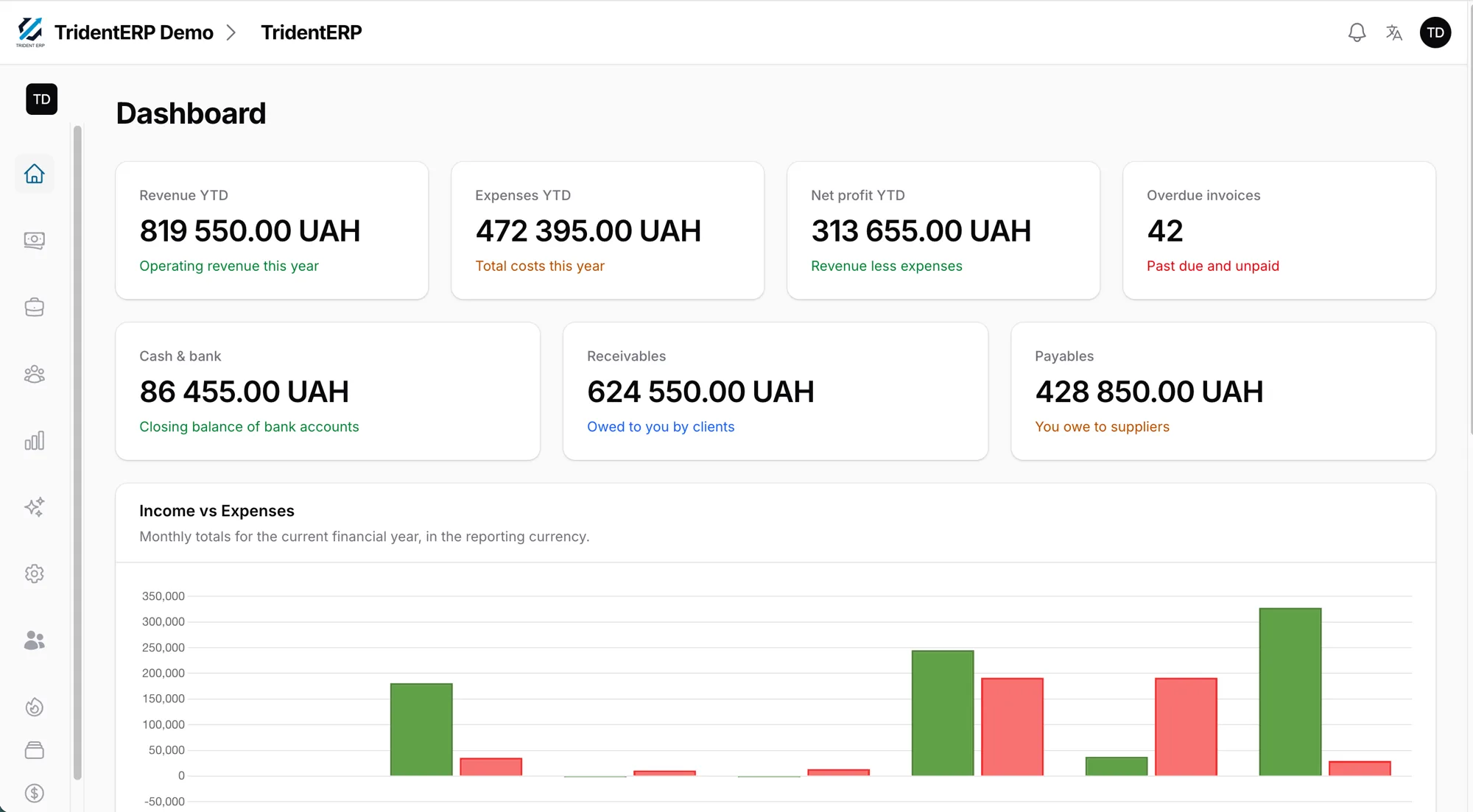
No sign-up: log in as [email protected] with password demo. Seeded books, nightly reset. What to look at in 5 minutes
- Double-entry ledger
- Multi-currency
- Human-approved AI
- Built for IT services
From a logged hour to closed books, without re-keying
Most agencies keep delivery, billing and accounting in three tools, so the numbers drift apart. Here the chain is one ledger.
-
Time
168,0
Hours logged against projects, by employees and contractors alike.
-
Rates
€45/h
Rate cards per client, project or person, with effective dates.
-
Invoices
€7 560
T&M, retainer or milestone drafts from the same hours, double-bill guarded.
-
Payroll cost
€4 690
Payroll posts to the ledger split per project by the hours worked.
-
Margin and reports
38,0%
Project P&L live, statements on demand, every figure drillable to its document.
| Line | Hours | Rate | Amount |
|---|---|---|---|
| Backend development | 96,0 | €45 | 4 320,00 |
| QA and code review | 40,0 | €45 | 1 800,00 |
| Project management | 32,0 | €45 | 1 440,00 |
| Total | 168,0 | €7 560,00 |
Billing that comes from the hours, not from memory
One click turns unbilled hours into an invoice draft. The same data serves three models, and hours already billed are guarded against billing twice.
- Time & materials from timesheets and rate cards, with per-entry overrides.
- Monthly retainers on a schedule, optionally with revenue deferral.
- Fixed-price milestones billed once approved.
- Project P&L with budget vs actual, billable utilization and outstaffing margin.
Accounting your auditor will recognize
Every invoice, payment and payroll run posts to a real double-entry ledger. A posted document cannot be quietly edited: corrections happen as credit notes, and the trail stays complete.
- P&L, balance sheet, cash flow, trial balance, client statements and aging.
- Any dashboard figure opens to the trial balance, the account card, then the source document: three clicks.
- Multi-currency with realized FX and period-end revaluation; VAT; fixed assets; revenue recognition.
- Configurable chart of accounts supports IFRS-based and local-GAAP reporting.
Acme GmbH · posted · due 15.09.2026
AI carries the busywork. People post the books.
Every AI action arrives as a draft or a suggestion, grounded strictly in your own company data. Nothing reaches the ledger without a human.
What AI does here
- Reads bank statements, even from PDF or a photo, and suggests the account per line.
- Turns receipt photos and supplier bills into drafts, line by line.
- Flags ledger anomalies nightly and suggests which invoices a payment clears.
- Answers finance and leave questions in a copilot, with report commentary on demand.
Under your control
- Per-company monthly AI budget, usage report, and an off switch.
- Bring your own Anthropic key, per company, on any plan.
- Personal data is redacted before anything leaves your system; nothing trains models.
- MCP server: connect Claude or any MCP client under your own role and permissions. Posting stays human.
European e-invoicing coverage and rollout
EU countries are moving B2B invoicing to structured e-invoices on different timetables. TridentERP exports EN 16931 UBL for every invoice, checks your requisites before anything is sent, and archives exchanged originals verbatim. Delivery connectors are listed per market with their current status.
- EN 16931 UBL export with a pre-flight readiness check on every invoice.
- Peppol delivery through an access point; inbound e-invoices pulled and staged for review.
- Poland: direct KSeF 2.0 connector issuing FA(3), no aggregator in between.
- Original XML archived verbatim, in both directions.
| Market | Mandate | TridentERP | Send / receive |
|---|---|---|---|
| Poland | KSeF mandatory for issuing from 1 February 2026 (sales above PLN 200 million in 2024) and from 1 April 2026 for other taxpayers; the smallest (up to PLN 10,000 per month) from 1 January 2027. Receiving through KSeF is mandatory from 1 February 2026. Official source · verified 6 Sep 2026 | Beta Direct KSeF 2.0 connector issuing FA(3), no aggregator in between. | Send |
| Belgium | Structured B2B e-invoicing over Peppol between Belgian VAT-registered businesses from 1 January 2026, per the announced federal mandate. Official source | Via partner EN 16931 UBL delivered through a Peppol access point; inbound documents are pulled and staged for review. | Send / Receive |
| Estonia | Since 1 July 2025 a buyer registered as an e-invoice receiver may require e-invoices (EN 16931 by default). B2G e-invoicing is mandatory. A general B2B mandate is planned for 2027, pending VAT Act amendments. Official source · verified 6 Sep 2026 | Beta Direct connector to the Finbite e-invoice operator (Peppol access point): outbound EN 16931 UBL addressed by registry code, inbound pulled into the inbox. Peppol access points remain available. Statutory filings for Estonia | Send / Receive |
| France | All companies must be able to receive e-invoices from 1 September 2026. Issuing: large and mid-size companies from 1 September 2026, SMEs and micro-companies from 1 September 2027, through approved platforms. Official source · verified 6 Sep 2026 | Roadmap EN 16931 UBL export today; transmission through an approved platform (PA) is on the roadmap. | Export only |
| United Kingdom | Mandatory e-invoicing for VAT invoices (B2B and B2G) announced for 2029; the standard is still to be chosen, with a roadmap due at Budget 2026. Non-VAT-registered businesses are out of scope. Official source · verified 6 Sep 2026 | Roadmap EN 16931 UBL export today; the delivery standard follows the government roadmap. | Export only |
| Ukraine | No B2B e-invoicing network; VAT payers register tax invoices in the unified register (ЄРПН) within the statutory deadlines. Official source | Beta Tax invoices (податкова накладна) as XML for registration in the ЄРПН through M.E.Doc, СОТА or the Tax Cabinet; acts of services rendered as the primary document; EN 16931 UBL export for foreign clients. Statutory filings for Ukraine | Export only |
Android available · iOS coming soon
Your companies in your pocket
The TridentERP mobile app signs in with your existing account and follows the same companies, roles and permissions as the web panel. Read what matters, create drafts on the go; posting to the ledger stays in the web app.
- Dashboard: receivables and payables, this month's P&L, balance sheet totals, with drill-down to account level.
- Client invoices and supplier bills with payment status, PDF sharing and draft creation.
- Clients and suppliers with search and country reference data.
- For the team: log hours, request leave and see the balance, open payslips.
- Who is in today: who is working, who is away and why; HR approves leave from the phone.
- English and Ukrainian, light and dark themes, two-factor sign-in.


Built to pass your security review
- Tenant isolation in the database
- PostgreSQL row-level security on every tenant table: even an application bug cannot read another company’s data.
- Roles and audit
- Granular permissions per role, read-only auditor access, activity log, two-factor authentication.
- GDPR in the product
- Data export and erasure flows for accounts and employees, encrypted sensitive fields, monitored backups.
- Dedicated server
- A separate server inside our infrastructure that holds only your company data, with its own backups and its own upgrade window, for teams that need full isolation.
Three prongs. One handle.
A services business stands on three prongs: projects and time, clients and money, people and payroll. Keep them in three separate tools and the numbers drift apart. The handle that holds all three is a single IFRS-ready double-entry ledger.
The name also nods to the tryzub, the trident on Ukraine’s coat of arms: TridentERP is designed and built in Ukraine.
The questions IT-services teams ask us most
TridentERP is an AI-first ERP built for IT-services companies. It connects the whole value chain of time tracking, client billing, and IFRS-ready double-entry accounting, and AI carries the busywork across it, from bank-statement import to drafted invoices, while every posting stays under human control.
Three ways, from the same data: time & materials generated from timesheets and rate cards, monthly retainers issued automatically, and fixed-price milestones. Invoices are created as drafts you review before posting, with a guard against billing the same hours twice.
Yes. Every project shows revenue, cost and margin as time is logged, along with budget vs actual, billable utilization, and outstaffing margin (bill rate versus contractor cost), so you know which work actually makes money.
Yes. TridentERP keeps a real double-entry ledger with reporting periods, so you can produce a P&L, balance sheet, cash flow, client statements and an aging schedule. Multi-currency, VAT, fixed-asset depreciation and revenue recognition are built in. The ledger is standards-agnostic: a configurable chart of accounts and accounting policies support IFRS-based as well as local-GAAP reporting; compliance itself depends on your policies and accountant.
Invoices export as EN 16931 UBL with a readiness check on requisites. Delivery connectors exist for Peppol (through an access point, sending and receiving) and for Poland's KSeF (direct, FA(3), sending); their current status per market is listed in the e-invoicing section above. Inbound Peppol documents are archived in the original form and staged for review before becoming bills.
Yes. Employees and contractors track time the same way; leave, holidays, payroll and per-diem are managed in one place, and worker cost flows straight into project profitability, split per project by hours worked.
They remove finance busywork: importing bank statements, reading receipts, flagging unusual ledger entries, and answering questions about your finances or leave. Always grounded strictly in your own company data, with a per-company budget and privacy controls.
No. AI features read only your own company data to do their job; nothing is used to train models. Each company sets its monthly AI budget, admins control who may use AI, and any AI action that would change the books arrives as a draft for human review.
Every plan includes a monthly allowance of AI credits: 2,500 a month on Starter, 1,000 per seat on Team and 2,000 per seat on Business. A credit is a unit of processing, not a token and not a provider dollar. Usage is metered per call and shown in the panel, so you can see what is left before it runs out. A company can lower its own ceiling at any time, and connecting your own Anthropic API key takes that usage off the plan allowance entirely. Admins decide who may use AI, and anything that would change the books still arrives as a draft for human review.
Yes. TridentERP ships an MCP (Model Context Protocol) server: connect from claude.ai, Claude Desktop, Claude Code or any MCP client. Sign in with OAuth or a personal access token, and the assistant sees exactly what you are allowed to see. It can look up clients and invoices, pull financial reports, and prepare draft invoices, proformas or timesheet entries; posting to the ledger stays a human action in the panel.
Explore the live demo to see billing, project profitability and accounting in action, then pick a plan. Role-based access lets you invite your delivery, finance and project managers with exactly the rights they need.
The name comes from the trident: the three prongs of a services business (projects & time, clients & money, people & payroll) held on one handle, a single double-entry ledger. It also nods to the tryzub, the trident on Ukraine’s coat of arms: TridentERP is designed and built in Ukraine.
See TridentERP on your kind of business
Leave your contacts and we will get back to you with a personal walkthrough: your workflows, your questions, real answers.
See your own routine in it, today
Seeded books, two demo companies, nightly reset. Look around freely.